

Why Your Customers' eSIM Feels Slow — And How We Fix It

TL;DR
Two eSIMs that both say 'Japan 5GB' can deliver wildly different experiences. The difference isn't coverage — it's routing. Home-routed roaming tunnels your traveler's data through a distant hub before it reaches the internet, adding up to 190ms of latency on every request. Local breakout exits the data in-country and feels 5–8× faster. About 34% of travel eSIM complaints are routing-related, not coverage-related. When you evaluate suppliers, price per GB tells you almost nothing — what matters is local MNO partner, routing type, activation success rate, throttling policy, tethering, top-up reliability, and 24/7 support. Journey Stack routes every activation to the best-performing provider per country, so your travelers get local breakout, low latency, and high activation success without you having to manage the complexity.
Your customer is in Tokyo. They activate their eSIM, get a signal, open Google Maps — and it takes 8 seconds to load. They try to book a restaurant on TripAdvisor. Timeout. They check their email. Slow. They call your support team and complain the eSIM "doesn't work."
But technically, it does work. They have data. The problem is where that data is going before it reaches the internet. This is the routing problem — and it's the single biggest differentiator between eSIM providers that nobody talks about clearly.
The Problem: Why Does Tokyo Feel Like London?
Two eSIMs can both promise "Japan 5GB" and deliver completely different experiences. One feels instant. The other feels broken. The traveler can't see the difference on the box — but they feel it the moment they tap an app.
| Metric | What it means for your traveler |
|---|---|
| 8× | Worse latency with home-routed connections vs local breakout |
| 34% | Of travel eSIM complaints are routing-related, not coverage-related |
| 190ms | Average extra round-trip delay when data routes through a distant hub |
How It Works: Two Routes To The Internet
When your customer uses data on a foreign network, there are two fundamentally different paths that data can take to reach the internet. Both start at the same physical cell tower. Only one ends well.
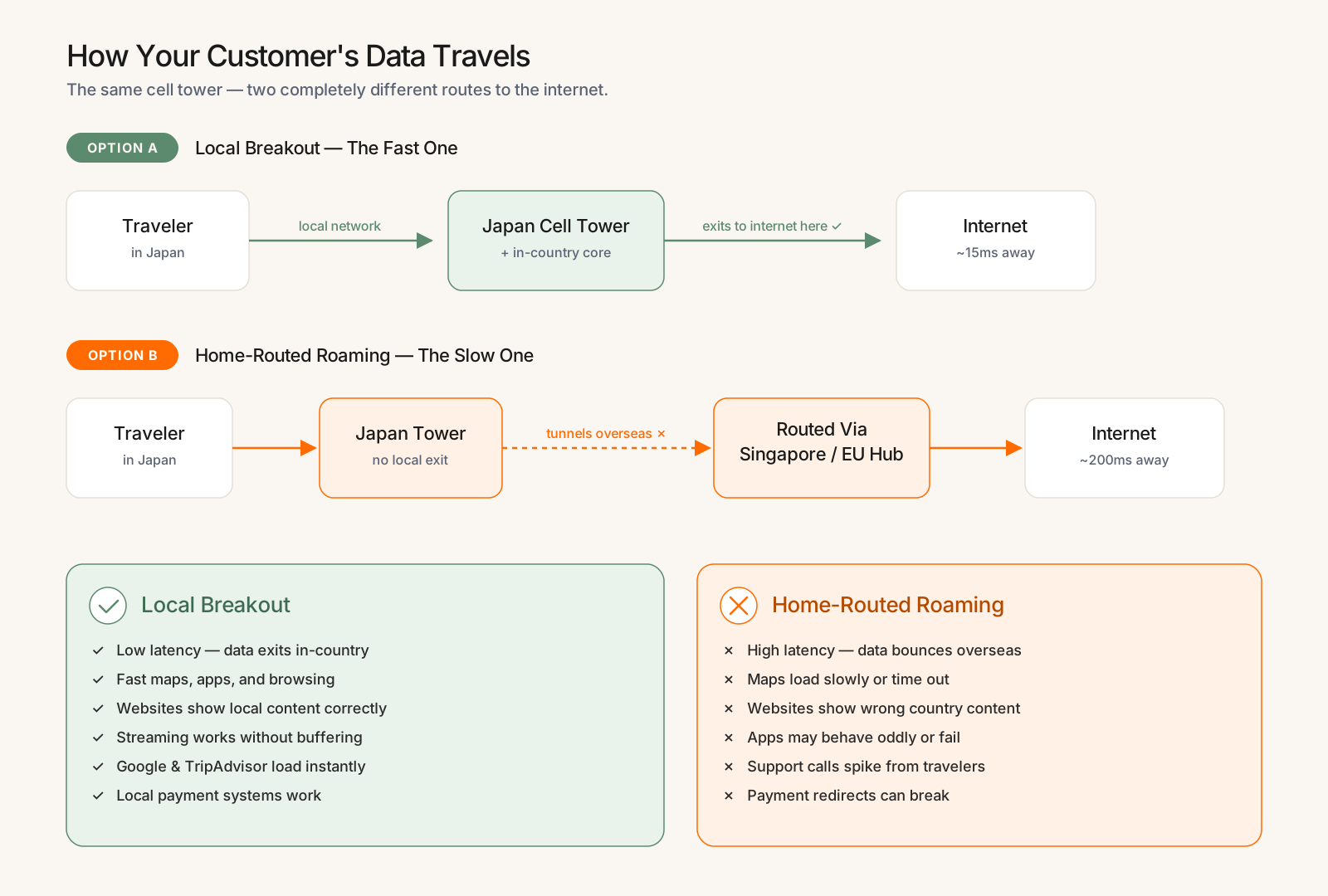
Option A — Local Breakout (The Good One)
- Path: Traveler in Japan → Japan cell tower + core → exits to the internet in-country → destination ~15ms away.
- Low latency — data exits in-country, so every request is fast.
- Fast maps, apps, and browsing — Google, TripAdvisor, Maps load instantly.
- Correct local content — websites detect Japan and show the right language, currency, and results.
- Streaming works without buffering.
- Local payment systems work — UPI-style redirects, 3DS, and bank flows don't break.
Option B — Home-Routed Roaming (The Slow One)
- Path: Traveler in Japan → Japan tower → tunnels overseas → routed via Singapore or EU hub → only then exits to the internet → destination ~200ms away.
- High latency — every packet bounces across an ocean before reaching the internet.
- Maps load slowly or time out.
- Wrong country content — Google shows Singapore results, booking engines load wrong currency.
- Apps behave oddly — geo-verified apps may refuse to work entirely.
- Support calls spike from confused travelers who "have signal but no internet."
- Payment redirects break when the bank sees a foreign IP.
The Data: What 190ms Actually Costs You
Here's a real-world comparison of average round-trip latency across popular travel destinations, between local breakout eSIMs and home-routed eSIMs. The difference isn't subtle.
| Destination | Local breakout (ms) | Home-routed (ms) | Delta |
|---|---|---|---|
| Japan (Tokyo) | 28 | 215 | +187 ms |
| Thailand (Bangkok) | 32 | 198 | +166 ms |
| United States (NYC) | 22 | 175 | +153 ms |
| United Kingdom (London) | 19 | 168 | +149 ms |
| UAE (Dubai) | 35 | 240 | +205 ms |
| Singapore | 18 | 162 | +144 ms |
Every tap, every page load, every map move adds ~200ms of invisible waiting. A 10-step navigation flow adds 2 full seconds of delay. Multiply that across a business trip and your traveler feels like their eSIM is broken — even though they have full signal bars.
App Performance, Scored Out Of 100
Beyond raw latency, home-routed connections create a subtle but frustrating experience that's hard to diagnose but easy to feel.
| App | Local breakout | Home-routed |
|---|---|---|
| Google Maps | 96 | 58 |
| WhatsApp calls | 94 | 62 |
| TripAdvisor | 92 | 49 |
| Uber / local ride-hailing | 91 | 44 |
| Bank / 3DS payments | 95 | 51 |
| Instagram / Reels | 93 | 60 |
The "Wrong Country" Problem
When data routes through Singapore instead of Japan, websites detect the traveler as being in Singapore. Google shows Singapore results. Booking engines load wrong currency. Some local apps that require geo-verification simply refuse to work. Your traveler calls support confused — because their connection technically works.
Supplier Evaluation: You're Not Comparing Price Per GB
When you evaluate eSIM suppliers, "5GB in Japan for $12" tells you almost nothing about whether your customer will have a good experience. Here's the full picture of what actually varies between providers.
- 1. Local network partner — Which MNO they've partnered with in each country. Tier-1 partners (NTT Docomo in Japan, AIS in Thailand) mean better coverage and routing.
- 2. Routing type — Local breakout vs home-routed. This single factor drives most of the experience difference.
- 3. Latency — Actual measured round-trip times in each destination. Ask for test data, not marketing claims.
- 4. Throttling policy — Does speed drop after a threshold? Some "5GB" plans are full-speed for 1GB then throttled to 256kbps.
- 5. Fair usage policy — Are hotspot and tethering allowed? Many plans quietly block sharing with a laptop.
- 6. Activation success rate — The % of eSIMs that activate first time. Poor SM-DP+ quality means stranded travelers.
- 7. Top-up reliability — If a traveler runs out of data mid-trip, can they add more instantly? Some providers fail here.
- 8. Support quality — When something goes wrong at 2am in Bangkok, who answers? And how fast?
Supplier Comparison Scorecard
How typical eSIM suppliers compare across the criteria that actually matter.
| Criteria | Budget reseller | Single-provider | Journey Stack |
|---|---|---|---|
| Local breakout routing | Rarely | Some markets | Default |
| Network partner quality | Unknown | One provider | Best per country |
| Activation success rate | ~82% | ~91% | >99% |
| Transparent throttling policy | Hidden | Partial | Full disclosure |
| Hotspot / tethering | Blocked | Limited | Included |
| Instant top-up | No | Delayed | Real-time |
| 24/7 traveler support | Email only | Business hours | 24/7 |
Our Approach: Why We Connect To Multiple Providers
No single eSIM provider has the best local network in every country. One carrier may have excellent local breakout in the US. Another may be the strongest in European markets through deep roaming agreements. A third may offer the best local partner in Southeast Asia.
Journey Stack sits above all of them. When your traveler activates an eSIM for Japan, we don't just pick any provider — we route to the one with the best local partner, lowest measured latency, and highest activation rate for that specific destination.Provider Coverage Quality, Scored Per Region
Quality score 0–100 per provider per region. Journey Stack routes every activation to the highest-scoring provider automatically.
| Region | Provider A | Provider B | Provider C | Journey Stack (best of) |
|---|---|---|---|---|
| North America | 92 | 74 | 68 | 92 |
| Europe | 71 | 94 | 79 | 94 |
| Southeast Asia | 66 | 72 | 95 | 95 |
| Japan & Korea | 78 | 70 | 88 | 88 |
| Middle East | 69 | 81 | 73 | 81 |
| Latin America | 74 | 67 | 82 | 82 |
The Compounding Advantage
When you use a single eSIM provider, you inherit all their weak spots. When you use Journey Stack, you get the best of each provider in each market — and we absorb the complexity so your travelers just get a fast, local connection wherever they go.
For Your Procurement Team: 4 Questions To Ask Any eSIM Supplier
Use these when evaluating any eSIM provider for your travel program. A supplier who can't answer these clearly is one you should be cautious about.
- Q1 — "Is this local breakout or home-routed roaming in [country]?" If they say "roaming" or can't tell you, it's likely home-routed. Walk away or proceed with eyes open.
- Q2 — "Who is your local MNO partner in Japan / Thailand / the US?" Tier-1 partners matter. Tier-3 partners on shared MVNO spectrum are much worse.
- Q3 — "What is your activation success rate, and what happens when it fails?" Anything below 97% at scale will generate support tickets. Find out if there's auto-retry and instant re-issue.
- Q4 — "Is speed throttled after a data threshold? Is hotspot included?" A 10GB plan throttled at 1GB will generate complaints. A plan with no hotspot will frustrate road warriors immediately.
The Bottom Line
Your customer doesn't care about routing tables, SM-DP+ servers, or breakout points. They care that Google Maps loads in Tokyo as fast as it does in their home city. Get the routing right, and the eSIM disappears — which is exactly what good infrastructure is supposed to do.
If you'd like us to run a latency comparison for the destinations in your travel program, talk to our team. We'll show you exactly what your travelers are experiencing today — and what they could be experiencing instead.
Further reading:Frequently Asked Questions
Local breakout means a traveler's mobile data exits to the internet in the country they're visiting, rather than being tunneled back to the provider's home network first. It dramatically reduces latency and makes apps, maps, and websites feel as fast as a local SIM.
Home-routed roaming tunnels every data packet from the visited network back to the eSIM provider's core network (often in Singapore, the EU, or the US) before it reaches the internet. That adds ~150–200ms of round-trip latency to every request, which makes apps feel sluggish even on a strong signal.
Ask your supplier directly per country. You can also test it: run a traceroute or check your apparent country on a service like ipinfo.io while connected. If you appear in a different country than the one you're physically in, you're being home-routed.
Because your data is exiting the internet in a different country than where you are. With home-routed roaming, geo-IP services see the provider's exit point — Singapore, for example — instead of your real location, so Google, booking engines, and local apps load the wrong region's content.
Anything below 97% will generate noticeable support tickets at scale. Premium providers operate above 99% with automatic retry and instant re-issue when an activation fails.
Journey Stack connects to multiple upstream providers and routes every activation to the one with the best local MNO partner, lowest measured latency, and highest activation rate for that specific country — so your travelers get local breakout by default, without you having to manage multiple supplier contracts.
Continue Reading


Stay Updated with Travel Tech Insights
Get the latest guides, industry trends, and tips to grow your travel business delivered to your inbox.