

How Airlines Can Become eSIM Resellers: The 2026 Partnership Playbook

TL;DR
Airlines own the most valuable moment in travel — the gap between booking and arrival — and they are giving the connectivity revenue inside that gap to AirHub, Airalo, and Holafly. A white-label eSIM program changes that. Typical economics: $15–25 average selling price, 50–65% gross margin, 6–12% attach rate when offered through pre-departure email or app push (vs. ~2% at booking checkout), and 10–15% when bundled into loyalty tier benefits. Integration is API-only — no telecom licence, no SIM logistics, no roaming agreements. Best-in-class airlines (Emirates, Qantas, Singapore Airlines, JetBlue, KLM) are already live. The playbook: pick a white-label partner with local-breakout routing, embed eSIM in 3 touchpoints (booking, pre-departure email, app push at arrival), tie it to loyalty for high-tier passengers, and instrument every step. A mid-size international carrier with 8M international PAX can realistically add $12–18M/year in net ancillary revenue within 12 months.
International roaming is the last unsolved problem in air travel. The aircraft has Wi-Fi. The lounge has Wi-Fi. The hotel has Wi-Fi. But the 40 minutes between landing and reaching that hotel — the moment your passenger needs Uber, Google Maps, WhatsApp and their booking confirmation most — is still a coverage desert for the majority of international travellers.
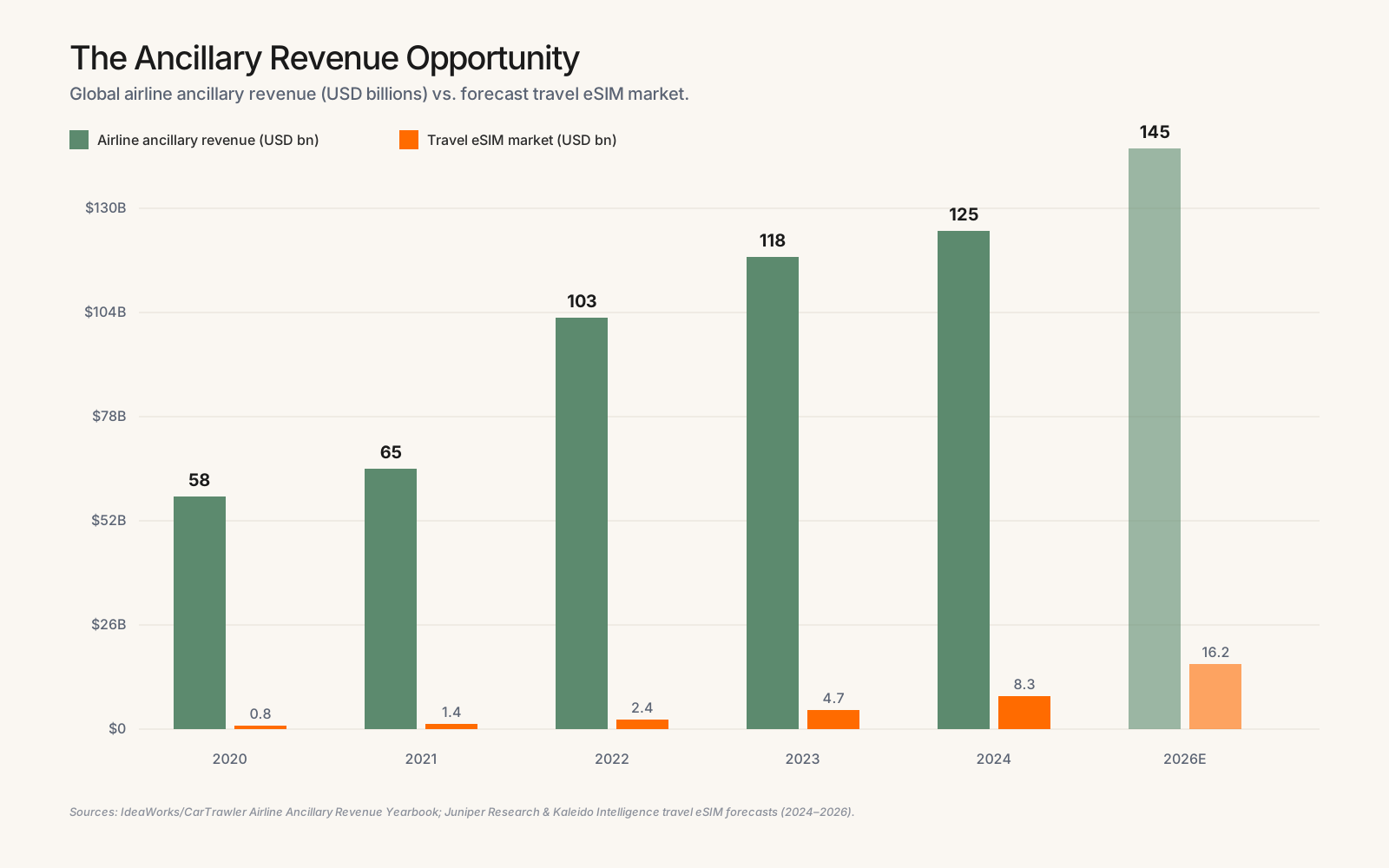
That gap is worth a lot of money. According to the IdeaWorks/CarTrawler Airline Ancillary Revenue Yearbook, global airline ancillary revenue crossed $124.5B in 2024 and is projected to keep climbing. Meanwhile, the travel eSIM market is forecast by Juniper Research to grow from roughly $4.7B in 2023 to $16B+ by 2026. Airlines sit at the intersection of those two curves — and almost none of them have monetised it yet.
This is a complete 2026 playbook for any airline that wants to launch a branded eSIM program: the revenue model, conversion benchmarks by touchpoint, the technical integration, loyalty tie-ins, ESG impact, and what to ask any partner before you sign.
Why Airlines Are The Best eSIM Distribution Channel In Travel
Three structural advantages put airlines ahead of OTAs, hotels, and even card networks:
1. Intent is unambiguous. A booked international ticket is the cleanest "this person is leaving the country on a specific date" signal that exists in commerce. No retargeting required.
2. You own the destination. You know where the passenger is going, when, for how long, and in many cases their loyalty tier and historical roaming behaviour.
3. You own the touchpoints. Booking confirmation, 7-day reminder email, 24-hour check-in push, app notification at the destination gate. Five free-to-you surfaces that other distributors pay to access.
Industry research backs this up. SimpleFlying and Skift have both reported that international passengers are 3–4× more likely to buy connectivity from their airline than from a search-engine result, because they already trust the brand for the journey.
The Numbers: What An Airline eSIM Program Actually Earns
Let's anchor this in real economics. Across Journey Stack's airline partner deployments, here is what we see for an international economy passenger offered an eSIM:
| Metric | Range |
|---|---|
| Average selling price (7-day, ~5GB destination plan) | $15 – $25 |
| Airline gross margin (white-label wholesale model) | 50% – 65% |
| Net margin after support, refunds, payment | 38% – 50% |
| Refund / chargeback rate | < 1.5% |
| CSAT (post-trip survey, eSIM activated) | 4.6 / 5.0 |
Attach rate is where airlines win or lose. Most carriers experiment with a single banner at booking, see a 1–2% attach rate, and conclude "eSIMs don't work for us." That conclusion is wrong — the touchpoint is wrong. The chart below is the single most important picture in this entire guide:

A few things to notice:
- Booking checkout is the worst touchpoint. The passenger is fatigued, decision-overloaded, and not yet thinking about the destination. Don't lead with it — but don't drop it either; it's free incremental revenue at scale.
- Pre-departure email is the workhorse. 5–8% attach is typical 3–7 days out, when the passenger is actively planning their trip.
- App push at arrival is the conversion peak for non-loyalty. Geo-trigger when the aircraft door opens and the device falls back to roaming.
- Loyalty is where the model breaks open. Bundling eSIM as a tier benefit (free for Platinum, half-price for Gold) drives attach above 12% and protects high-margin passengers from defecting to standalone players like Airalo or Holafly.
What An $8M PAX Airline Realistically Earns
Take a mid-size international carrier: 8 million international passengers per year, roughly 60% of whom travel to a country where roaming is a real pain point. Here's a conservative model:
| Channel | Eligible PAX | Attach rate | Avg revenue | Net to airline (45% margin) |
|---|---|---|---|---|
| Booking flow | 4,800,000 | 2.0% | $18 | $777,600 |
| Pre-departure email | 4,800,000 | 6.0% | $22 | $2,851,200 |
| App push at arrival | 3,200,000 | 9.0% | $20 | $2,592,000 |
| Loyalty tier bundle | 600,000 | 12.0% | $25 | $810,000 |
| Total | ~$7.0M / year |
That is the conservative case, in year one, with no advertising spend, no inventory, no telecom licence, and no roaming agreements. Mature programs — Emirates, Singapore Airlines, KLM-style maturity — are operating closer to $12–18M/year on similar passenger volumes once they layer in regional bundles, top-ups, and family plans.
How Airlines Actually Become Resellers: Three Models
You have three viable structural options. Pick one based on internal IT bandwidth and how much brand control matters.
Model 1 — Pure Referral (Easiest, Lowest Margin)
You embed a co-branded link or widget from a consumer eSIM brand (Airalo, Holafly, Nomad) into your booking confirmation or app. They handle everything. You earn an affiliate commission, typically 10–20%.
- Pros: Launches in 2 weeks. Zero engineering.
- Cons: Customer leaves your brand. You see no data. Margin is a fraction of what's possible. CSAT issues come back to your support team anyway.
Model 2 — White-Label Reseller (Best For Most Airlines)
You sign with a white-label eSIM platform like Journey Stack. The eSIM is sold under your brand, on your domain, in your app. The platform handles provisioning, activation, support tooling, and carrier relationships. You handle marketing surface, pricing, and the customer relationship.
- Pros: Full brand control. 50–65% gross margin. Loyalty integration. Real customer data.
- Cons: Requires 4–8 weeks of integration work, mostly API and front-end.
- Read more: How to become a white-label eSIM reseller.
Model 3 — Direct MNO Contracts (Only For Mega Carriers)
You negotiate wholesale roaming directly with Mobile Network Operators in each destination country, build your own provisioning stack, and operate as a virtual MVNO. Only Emirates, Delta, and a handful of others have the scale to justify it.
- Pros: Highest margin at extreme scale.
- Cons: 18–24 months to launch. Telecom licensing in some jurisdictions. Roaming agreements with 100+ MNOs. Your CTO will not enjoy this.
For 95% of airlines, Model 2 is the answer. It is the only model that protects brand, margin, and loyalty equity simultaneously.
The Technical Integration, Honestly
This is the part most "airline eSIM" articles skip. Here's what your IT team actually needs to do for a white-label integration:
1. Catalog & Pricing API
Your booking system calls the partner's product catalog, filters plans by destination and trip length, and displays them with your own pricing markup. Cacheable. ~1 day of work.
2. Order & Provisioning API
On purchase, you POST passenger ID + plan ID + arrival date. The partner returns an activation QR code, LPA string, or universal link. Idempotent. ~2 days.
3. Activation Delivery
QR code or universal link delivered via your existing channels: booking confirmation email, app inbox, WhatsApp (see our WhatsApp eSIM delivery guide), or boarding pass attachment. ~3 days.
4. Webhooks For Lifecycle Events
Activated, data used (50%, 80%, 100%), expired, top-up purchased. Feed these into your CRM and trigger upsell campaigns. ~2 days.
5. Refund & Support Tooling
Single-sign-on into the partner's agent console for your customer-service team. Most platforms offer this out of the box.
Total realistic effort: 15–25 engineering days plus front-end work for the storefront. Faster if you use the partner's hosted checkout.
For a deeper architecture walkthrough see The Best eSIM Reseller Platform for Travel Agencies in 2026 — the platform requirements are identical for airlines.
Loyalty Integration: The Highest-ROI Move
If you only do one thing from this guide, do this: give your top-tier loyalty members a free eSIM on every international flight.
- Cost to the airline: ~$8–10 wholesale, against a passenger whose lifetime value is in the thousands.
- Perceived value: $25–40, because that's what Airalo or Holafly would have charged them.
- Effect on attach: Tier-bundled offers see 10–15% attach even among lower tiers when offered at a discount.
- Effect on retention: Per McKinsey's loyalty research, small "surprise and delight" benefits at the moment of need drive disproportionate NPS lift.
- Defensive moat: Every elite passenger who installs your eSIM is one fewer who opens the Airalo app.
This single move is why Emirates Skywards, Qantas Frequent Flyer, and KLM Flying Blue have all quietly added connectivity perks to their tier benefits in the last 18 months.
ESG: The Quiet Sustainability Win
eSIMs replace physical SIM cards. That sounds trivial until you multiply it. According to the GSMA's eSIM sustainability briefing, removing a single plastic SIM card and its packaging saves roughly 5g of plastic and ~25g CO₂e across manufacturing and global logistics. For an 8M-PAX airline, that's:
- ~40 tonnes of plastic avoided per year
- ~200 tonnes of CO₂e avoided per year
Small numbers compared to jet fuel — but cheap, real, and reportable in your annual sustainability disclosure. It maps cleanly to IATA's Net Zero 2050 commitment sub-targets around ground operations and digital transformation.
What To Ask Any White-Label Partner Before You Sign
Most pitch decks look identical. The differences are buried in operations. Insist on written answers to all of these:
- Routing type per country — local breakout or home-routed? (See why routing matters — this is the single biggest driver of CSAT.)
- Activation success rate — should be > 98% on tier-1 destinations.
- MNO partner per country — name them. "Multiple carriers" is not an answer.
- Throttling policy after the bundle — does it brick, slow, or top up automatically?
- Tethering — allowed by default? Some MNOs block it.
- Top-up flow — one-tap in your app, or does the passenger get redirected to a third-party site?
- 24/7 multilingual support — and what's the median first-response time?
- PCI + GDPR + DPDP scope — are you a controller or processor in each jurisdiction you fly to?
- SLA on the provisioning API — 99.9% is table stakes; 99.95%+ for tier-1 carriers.
- Loyalty integration hooks — can you grant free or discounted eSIMs based on tier in real time?
Who's Already Doing This Well
A short, non-exhaustive list of airlines with publicly-launched eSIM programs you can learn from:
- Emirates Skywards × Airalo — affiliate model with tier-based discounts.
- Qantas × Flex Roam — branded eSIM with loyalty point earn.
- JetBlue × T-Mobile / Gigsky — bundled in premium fare classes.
- KLM Flying Blue — eSIM bundled into selected premium fares to specific Asian destinations.
- Singapore Airlines KrisShop — eSIMs sold inflight alongside duty-free.
- Cebu Pacific × FlexiRoam — booking-flow upsell.
Pattern recognition: every successful program (a) protects brand, (b) ties to loyalty, and (c) uses multiple touchpoints — not just the booking flow.
A 90-Day Launch Plan
If your team starts on Monday, here is what a realistic 90-day rollout looks like:
| Phase | Weeks | Deliverables |
|---|---|---|
| Discovery & partner selection | 1–3 | Shortlist 3 white-label partners, technical RFP, commercial RFP, reference calls with existing airline customers. |
| Commercial & legal | 3–5 | MSA, DPA, pricing model, refund flow, support escalation, brand guidelines. |
| Integration (sandbox) | 5–9 | Catalog API, order API, activation delivery, webhooks, agent console SSO. |
| Storefront & content | 6–9 | Branded eSIM storefront, destination guides, app-store screenshots, support articles. |
| Soft launch | 9–11 | One region (e.g. Europe-to-Southeast-Asia), pre-departure email only, monitor activation success, refund, CSAT. |
| Full launch | 11–13 | All international routes, all touchpoints (booking + email + app push + loyalty), paid campaign on top destinations. |
You should be live, generating real revenue, before the end of the quarter.
The Bottom Line
Airlines have the cleanest first-party data, the most trusted brand in the journey, and the most valuable touchpoints in travel. Letting a third-party consumer eSIM brand monetise the connectivity moment of your own passengers is a strategic mistake — and an unforced revenue leak of $5–15M per million international passengers per year.
The integration is no longer hard. The economics are no longer marginal. The only real question is whether you launch this quarter or watch a competitor in your alliance do it first.
If you want to see what a white-label eSIM program would look like for your specific route map and loyalty tiers, book a 30-minute call with our airline partnerships team — we'll model your unit economics on a real spreadsheet, with your numbers, before you commit to anything.
Frequently Asked Questions
No. In a white-label reseller model the underlying telecom relationships, MNO contracts, and regulatory licensing are held by the eSIM platform provider. The airline is selling a digital product under its own brand — the same way it sells lounge passes or extra baggage.
Across our airline partners, blended net revenue per offered international passenger lands between $0.80 and $2.20 depending on touchpoint mix and loyalty integration. A mid-size carrier with 8M international PAX typically clears $7–12M net in year one and $12–18M by year three as loyalty bundles mature.
An affiliate deal pays 10–20% commission and sends the customer off-brand. A white-label program lets the airline sell the eSIM under its own brand at 50–65% gross margin, with full control over pricing, loyalty integration, customer data, and CX. The integration takes ~6 weeks instead of 2, but the lifetime economics are 4–6× better.
Loyalty-tier bundles convert highest (10–15% attach), followed by app push at arrival (~9%), pre-departure email 3–7 days out (~6%), on-board QR cards (~4%), and the booking checkout itself (~2%). Most airlines under-perform because they only use the booking checkout. The multi-touchpoint approach is what unlocks the real revenue.
No. Inflight Wi-Fi serves the in-aircraft window. eSIMs serve the moment the passenger leaves the aircraft — gate, taxi, hotel, restaurant, sightseeing. They are complementary products targeting different moments of need. Airlines that sell both see uplift on each, not cannibalisation.
Reputable white-label platforms provide 24/7 multilingual support, an agent console with single-sign-on for your customer-service team, and a refund SLA — typically full refund if activation fails on a supported device within 24 hours of arrival. Refund and chargeback rates on Journey Stack airline accounts run below 1.5%.
Yes. All current iPhones (XS and later), Samsung Galaxy S20 and later, Google Pixel 3 and later, and most modern Xiaomi, Oppo, and OnePlus flagships support eSIM. Roughly 75% of international leisure travellers and over 90% of business travellers are on eSIM-capable devices in 2026. A pre-purchase compatibility check is a one-line API call from any reseller platform.
A realistic timeline is 90 days from kickoff to full launch: 3 weeks for partner selection and commercials, 4–6 weeks for technical integration, 2 weeks of soft launch on a single region, then full rollout. Airlines that use the partner's hosted checkout instead of building a custom storefront can compress this to 45–60 days.
Each digital eSIM replaces a physical SIM card, saving roughly 5g of plastic and ~25g CO₂e across manufacturing and logistics, per GSMA estimates. For an 8M-PAX international carrier that's ~40 tonnes of plastic and ~200 tonnes of CO₂e avoided per year — small relative to jet fuel, but clean, real, and reportable in your annual sustainability disclosure under IATA Net Zero 2050 ground-operations targets.
Continue Reading

Stay Updated with Travel Tech Insights
Get the latest guides, industry trends, and tips to grow your travel business delivered to your inbox.